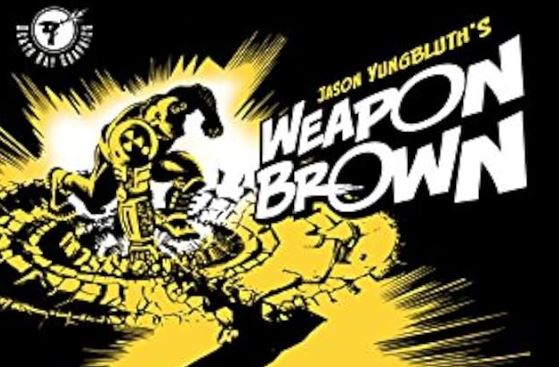
Weapon Brown is a comic book published by Death Ray Graphics and written by Jason Yungbluth. Initially released in 2002, it parodies the Peanuts and other classic funny-pages characters by putting them in a post-apocalyptic world with much more adult themes. It’s like Mad Max but with iconic comic strip characters. It’s filled with funny ideas, incredible action, and some decent worldbuilding, but it still ultimately falls flat.
A lot of it does work. Seeing recognizable characters like Charlie Brown, Calvin and Hobbes, Dilbert, and Little Orphan Annie in such a wildly different light is exciting and leads to plenty of fantastically dark humor. A couple of the one-off stories are genuinely quite interesting, like Linus starting a cult to summon the Great Pumpkin and Lucy using her expertise as a psychiatrist to mentally reprogram super soldiers. The fight scenes are appropriately violent and wildly creative.
There are plenty of moments throughout, though, that distract from enjoying this unique take on beloved characters. For starters, there are far too many jokes and pieces of imagery that are just plain racist or sexist.

A joke about Franklin being the only black member of the Peanuts is a humorous way to poke fun at a fact about the original comic strip. However, it’s done in a rather tasteless way here. Having Peppermint Patty and Marcy be in a relationship is quite funny and feels accurate to the original version. Having Peppermint Patty run a brothel and sleeping with the workers is a bit uncomfortable. Having the MacGuffin of one of the stories be a woman’s breast milk that’s so delicious that every man needs a taste and her owner keeping her breasts locked up as a result is just plain cringy.
Sure, Mad Max, which this comic clearly takes inspiration from, touches on plenty of the same themes and ideas. That being said, it does so in a much better way. It shows things like slave brides as being negative. The hero of the story doesn’t participate in such terrible activities. He also rescues those in distress rather than leaving victims with their abusers. Here, Weapon Brown doesn’t seem to care if these folks need help as long as he’s getting paid, and even enjoys taking part in the chase for the breast milk of slave brides.
It’s also worth noting that while some of the stories are a lot of fun, the overarching plot isn’t all that fascinating. There’s nothing really connecting any of it. There’s no big bad for the whole series and no real arc for Weapon Brown. After he takes out Lucy and Linus, he just sort of goes on missions for payment. A one-off issue of this isn’t too bad, but the whole series of the character just sort of “doing things” gets full over time. If the creator took one of the better standalone stories and made that the central plot for the series that ties the rest of the subplots together, it all would have worked better. It all would have been a much more intriguing story to continue reading.

One last element worth discussing is the artwork. The art is mostly rather impressive throughout and uses an eye-catching and detailed style. Unfortunately, though, there are times in which a panel is so overly detailed that it’s difficult to tell what’s going on in it. This only occurs a few times in the comic, but it stands out when it does. Thankfully, most of the art is a treat to look at.
Overall, Weapon Brown is a mixed bag. It feels like it missed the mark just a bit too much, which is especially unfortunate because it could have easily been something special.
Read Next: Batman: The Brave and the Bold’s ‘Heroes of Tomorrow’ Needs to Continue
 Nonstop Nerd